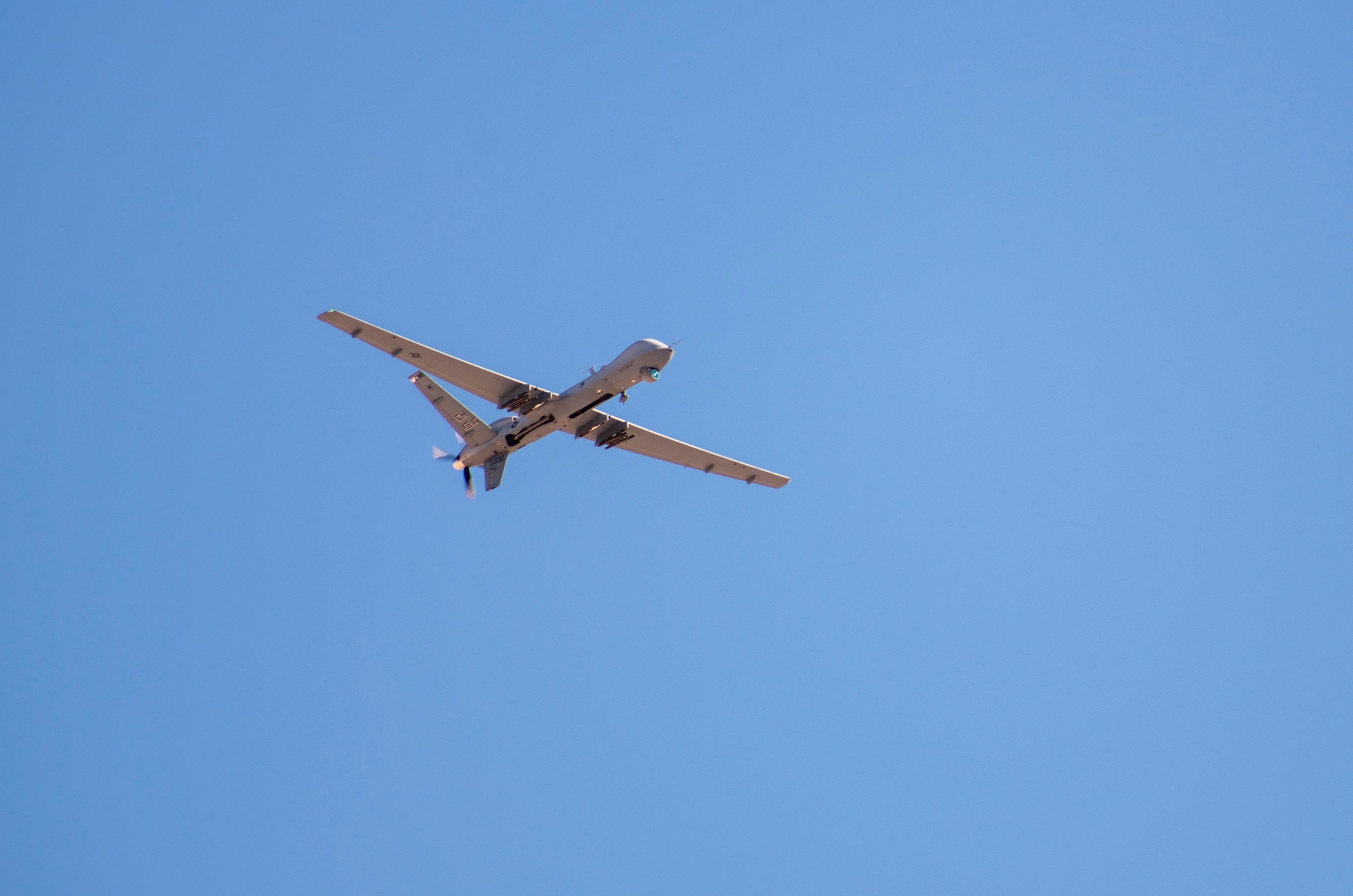
An MQ-9 Reaper over Nellis Air Force Base, Nevada, November 2019. U.S. Air Force photo by Staff Sgt. Omari Bernard.
The MQ-9 is being lost faster than anyone planned for. Houthi fire brought down seven of them in under six weeks in the spring of 2025. It has been worse since operations against Iran began in February. News reports put the losses at 24 by April, and the Washington Post has since reported, citing three U.S. officials, that at least 45 have been lost, about a quarter of the fleet. In May the Air Force told the Senate it was down to roughly 135 Reapers against a floor of 189.
None of that is a knock on the Reaper. It was built for airspace where the other side couldn't do much about it, and for most of its career that's where it flew. It was never designed to hide, and it's flown by a crew over a satellite link. Against an adversary with real air defenses, both of those things become the problem.
The Air Force's answer is the Massed Modular Aircraft, a competition the Department of War Innovation Unit opened in July for a cheaper, mass-producible successor built with attrition in mind. An Air Force official has put it at roughly ten million dollars per air vehicle, with probably at least 180 fielded. Concept refinement is expected to start this quarter.
We think that gets the cost half right and leaves the other half open. Going after cost is correct, and we've said before that it has to be a requirement from the first drawing rather than something you find out at the end. But an aircraft that can't survive the airspace it's sent into doesn't stop being lost because it got cheaper. The losses come down in dollars. They don't come down in missions.
In defended airspace the question isn't only what the aircraft costs. It's whether it gets there, collects what it was sent for, and comes back with it. That asks for two things the Reaper never needed. A shape that's hard to find, and enough autonomy on board that the aircraft can keep working when its link is jammed, because transmitting from inside defended airspace is a good way to get found.
Neither of those costs what it used to. A lot of low observability is decided by shape and materials, and composite structures with real geometric complexity are now within reach of a small team. Small turbofans come out of a catalog. A lot of what used to make an aircraft like this cost a fortune was how it got built, not what it was.
That's the aircraft we're building with Specter. The argument doesn't depend on us, though. If the Reaper's replacement is only cheaper, the Air Force ends up back here in a few years, buying more of something it keeps losing.